The 2025 class reunion in Trollhättan for the “student 1960 in Uddevlla” gang ended a little sadly. Not because our annual meetings are ending – they will probably continue as they have for 25 years. But because the hostess Birgitta is selling the apartment we were staying in on Ångloksgatan. Because she wants to get closer to her children and grandchildren in Strömstad.

Although the real estate agent’s Photoshopped photos didn’t capture the soul of the home, at the dining table we realized how the floor plan encourages togetherness.
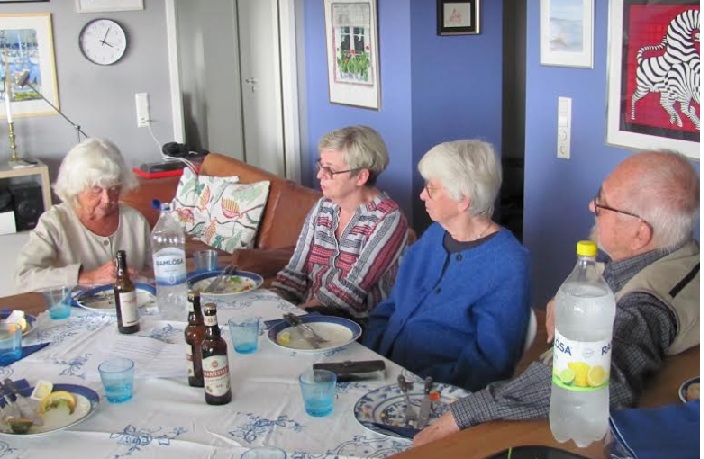
Exchanging life stories

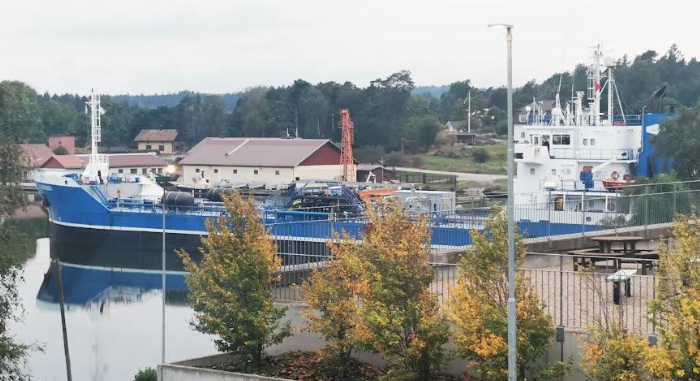
Even more so on the balcony, with a view of Åkers sjö – the basin that unites the three lock areas. From 1800, 1844 and 1916, and then continuing north along a canal past the rapids. As requested, in the evening we saw a ship glide past the balcony window.
Class reunions can often turn into superficial small talk – “how many children do you have?”, “what do you do for a living?” Not so with us. We exchange life stories.
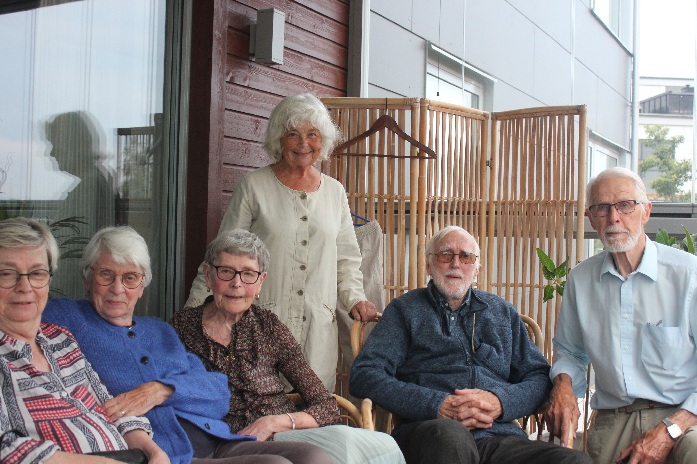
Anitha, who lived in Rome and Jakarta because her Nils built boats. Lasse, who dedicated his life to AXE switch at Ericson. Inger, who taught the kids of Vänersborg to cook. She lives in Intagan, just under a mile downstream from the river – where we had our class reunion in 2013.
Gittan in historical light
From the balcony we saw the Russian Crane, which in the years after the revolution was used to ship a thousand locomotives to Russia. A couple of thousand of these locomotives (with steam turbines invented by Uddevallason Birger Ljungström) were manufactured at Nydqvist & Holm – just a few steps from Birgitta’s Ångloksgatan.
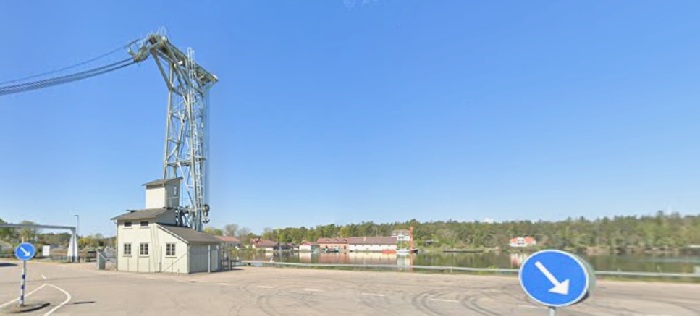
The Canal Museum can be seen on the other side of Lake Åkersjö, at the inlets to the 1800 and 1844 lock canals.
NOHAB, which is the short name, suffered from the industrial death – like Saab and several other factories. The premises now house Innovatum Science Park , with a vision that reflects the history of the industry.

Here you will find Film i Väst and the Saab Car Museum – where Birgitta would be a good fit. For many years she worked at Saab, with both ADB and personnel issues. She also landed at Volvo Flygmotor (now GKN Aerospace), which spun off from NOHAB during World War II.
Absent friends
NOHAB’s water turbines can be seen in Olidan’s power station , a fifteen-minute walk from Ångloksgatan. The turbines drove and still drive generators from ASEA, the company built up by CEO Sigfrid Edström from Edshult on Orust – not far from Aina Barnevik’s childhood home.
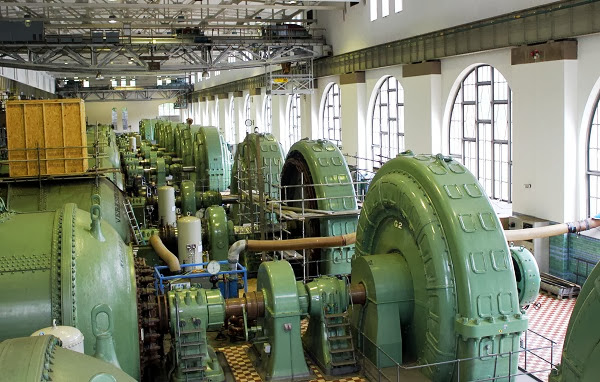
Edström is considered Sweden’s foremost industrial builder during the first half of the 20th century, in the same way that Percy Barnevik with Asea/ABB achieved similar fame during the second half. Where did Aina and Percy graduate? At Uddevalla General Education in 1960!

The photo shows classmate Inga-Maj on a previous class visit to Olidan . At Flottbergsbron, as the suspension bridge is called, there are remains of Elvius lock, blasted out of the rock in 1754. Never in use because the dam above collapsed.
The contemporary Ekeblad lock , at the current Strömkarlsbron, fared equally badly . It was used only once, to lock King Adolf Fredrik. Between these two fiascos is Polhem’s lock , which remained with a large hole in the rock. It can be seen at Hajums power plant.
Neither Inga-Maj nor Urban could attend this year’s meeting. Too bad because he, who grew up near the water tower, seems to be a celebrity in town. After many years in his career at Astra in Södertälje, he sailed the sailboat past Trollhättan. A voice from the quay was heard shouting ”isn’t that Urban Stenhede there?” It was a friend from his childhood who had moved to Australia and happened to be on a two-day visit to his hometown.
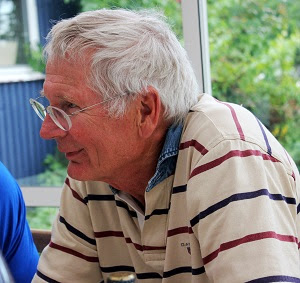
Inger

Inger lives in Intagan one kilometer downstream of the river , where the bar iron was shipped out before the lock was built. Right on the edge of the great landslide of 1648, which blocked the river and drowned people and livestock between Lilla and Stora Edet (Trollhättan). The earth masses can still be seen towering up. Land from Intagan that slid over to the Swedish side was seen by some as an advance on the conquest of the entire landscape ten years later.
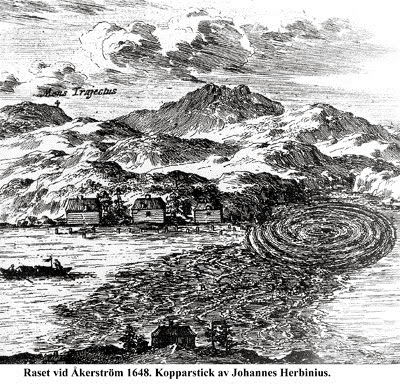
The people of Uddevalla were so happy to become Swedes that they erected a statue of Charles X in the square, according to our teacher Nils Uthorn. In addition to the fire and the missing herring, it was the Trollhättes locks that took a toll on the port town of Uddevalla in the early 19th century. A consolation was Ivar Kullgren’s deliveries of stone from the Bohus coast to the lock construction inaugurated in 1844. The stone house by the Bäveån can be seen as a monument to Kullgren’s widow .

The fact that the Intagen people lost the national border to Åkerström was something to live with. Worse was that the deliveries of bar iron (with up to a thousand horses on Edsvägen) were cut off by the lock construction. The first in Karlsgrav 1754 – near the Rånnum estate where young Thomas Thorild from Toröd by Bullaren was an informant. Unhappily in love with his student, the daughter of the rich supercargoer in the East India Company.
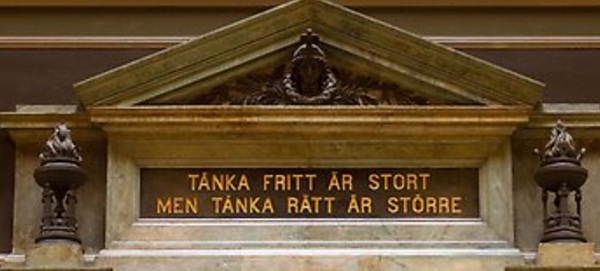
From Inger’s house you can dream of history. In 1064, Harald Hårdråde’s people were seen rowing past here with about sixty ships that had been summoned in Kungahälla. They were dragged in the towpaths past the rapids (other guesses on Edsvägen) up to Lake Vänern. There the king tried to capture Earl Håkon Ivarsson, who due to tricky tax collection was on the run from the kingdom of Lyd in Gudbrandsdalen. Could it be the remains of such a ship that were found in Åkersjö when the canal was being dredged?
Storyteller

Our shipbuilder Nils could fill in the historical shipyard interest from the balcony. In the spirit of watching the Vänernskutor warp past the currents. Beautiful sailing ships that after the middle of the century were crowded with machine-driven ships, some with technology from NOHAB.
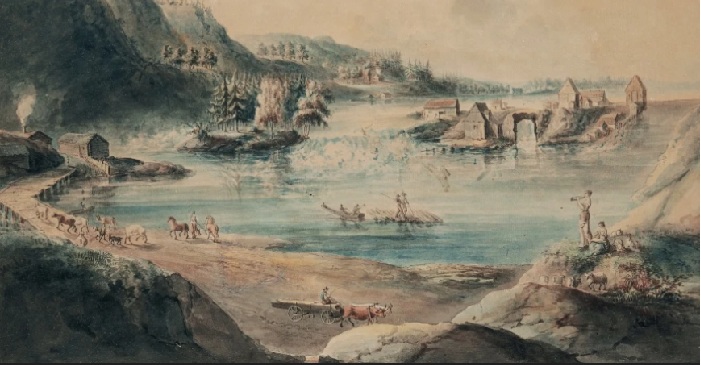
In 1849, Nils had seen the paddle steamer Götheborg pass by – then a novelty in traffic between the west coast and Trollhättan. The lock took three hours, so the passengers had plenty of time to visit the falls. One was HC Andersen, who admired the landscape here and was impressed by the technological achievements.
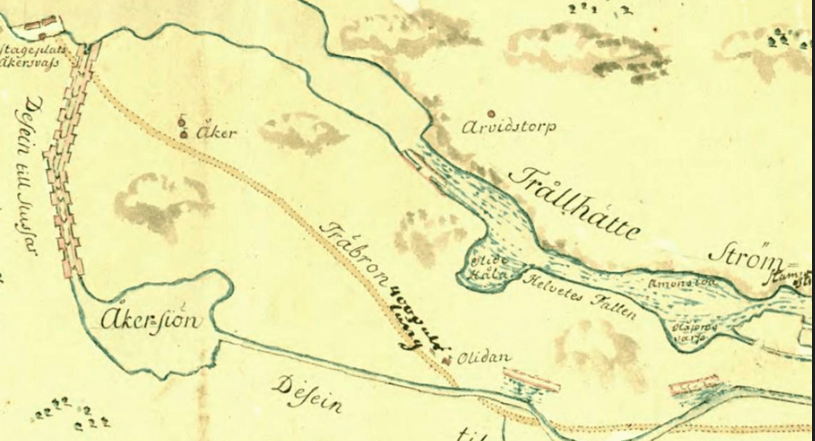
Surrounded by boys willing to guide him, he hiked past Åkers sjö up to Helvetesfallen above Olidanhålan.
“What a sight, what a shower, above, below! it is like the waves of an ocean, but an ocean of foaming champagne, of boiling milk,” he writes. “At the top two rocks splash, so that the water dust rises like meadow mist, below the water is more concentrated, rushes again, shoots forward and goes back in a circle like thin water, and then it overturns in that hellish fall its long sea-heavy fall.”
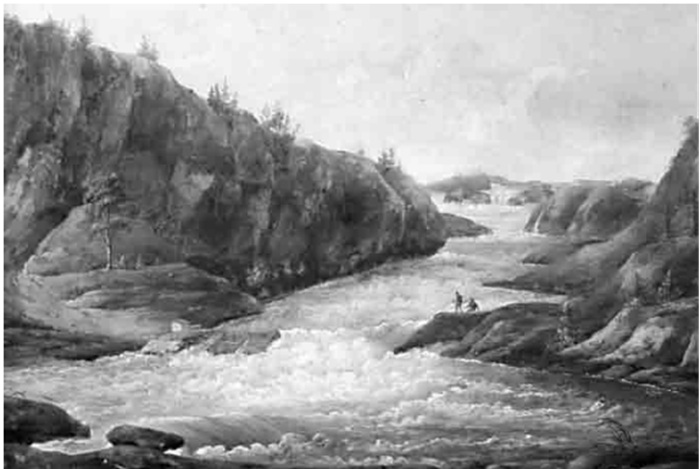
Andersen was told the ancient tale of how Hergrimer killed the giant Stærkodder at this waterfall. Trollhättan gets its name from the medieval belief that trolls sat on “caps” in the rapids, that is, the rocky outcrops. Fairy tales to prevent children from falling in, completely to Andersen’s taste.
Up at Toppön, the storyteller heard the poem Svea by Esaias Tegnér, who was here in 1805: ”Wild Göta fell from the mountains, Horrible Troll from his Topfall rotted! But the Genius came and burst the Slope stood, With the ship in its wake!”
Science and romance
Carl von Linné and his disciple Pehr Kalm made a detour to Trollhättan in the 1740s. Kalm tells of a scientific experiment. A live pig, a small house and a barrel were dropped down the falls. They became coffee wood, except for the pig that survived.
Perhaps Tegnér was inspired by a first-born of Romanticism. After her trip to Norway in 1795, Mary Wollstonecraft took a detour past Trollhättan before picking up her daughter in Gothenburg. The travelogue, which was also an inner journey, made her a style icon for many on a Nordic Grand Tour.
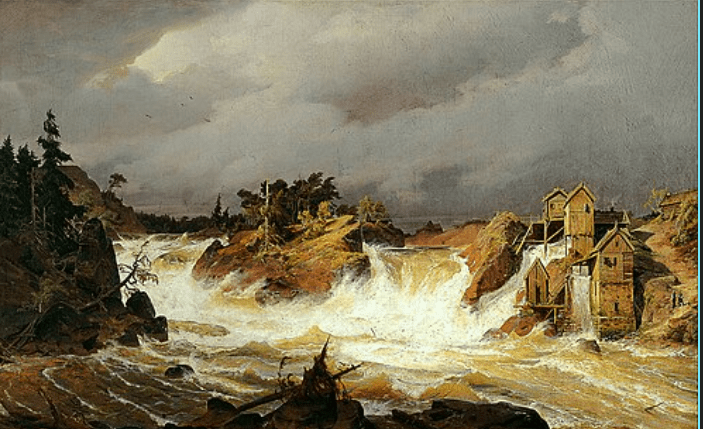
Wollstonecraft “ A small island stood in the middle, covered with firs, which, by dividing the stream, made it more picturesque; one half seemed to issue from a dark cavern, an imagination which might easily imagine a vast fountain throwing up its waters from the bowels of the earth . ”

Did she spare Thorild a thought when his birthplace in Svarteborg was passed? Both were early feminists. She with Vindication of Rights in 1792, he with On the Natural Highness of the Female Sex the following year. Although in 1795 he was exiled to Greifswald in Pomerania for his rebelliousness.

/ By Ingemar Lindmark
We who met in 2025:
- Birgitta Rhedin
- Inger Hallberg
- Lars Erik Hallenfur
- Anitha and Nils Emanuelsson
- Ingemar and Lena Lindmark
 Magasin Hällungen