
The very first week I moved into I17 in 1960, we had to stand guard with live-loaded weapons. One of the guards encountered a person in the regiment’s bandstand who pointed a pistol at him in the dark. Which prompted the friend to fire a volley. The only damage was a shattered mirror.
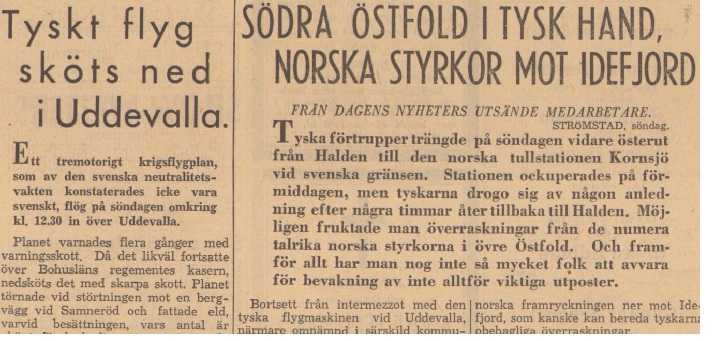
Was the German Junker who was shot down with cannons on the Music Field next to the pavilion also a legend? Here we will show that the story is actually true .
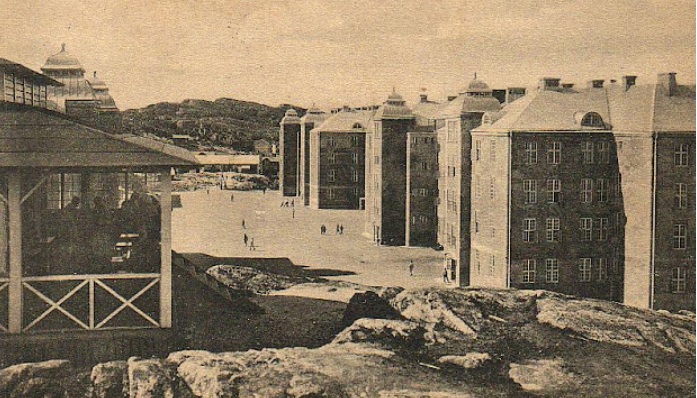
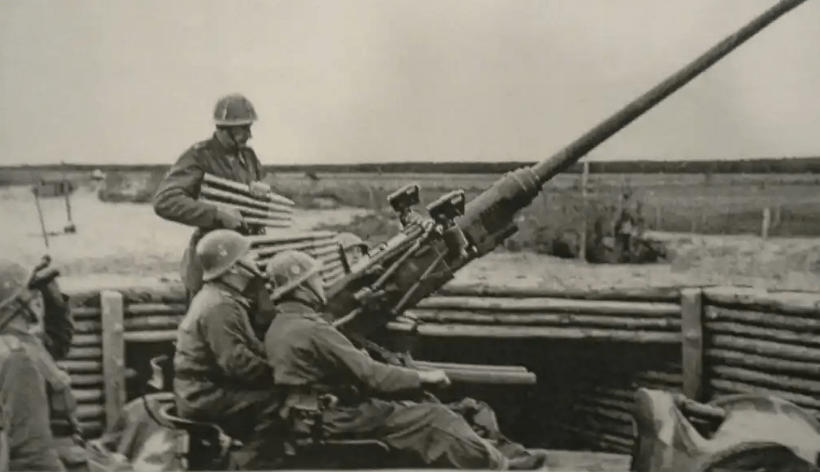
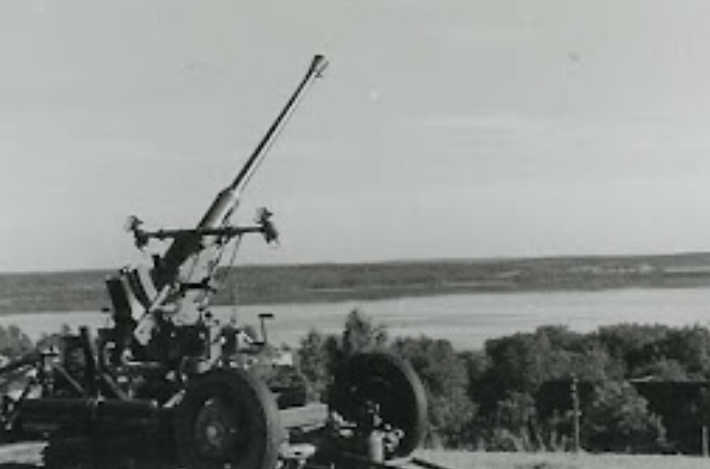
The Germans entered Norway on April 9, 1940 and were seen at the Bohuslän border gates a few days later. The Luftwaffe flew unconcernedly over northern Bohuslän because we lacked anti-aircraft defense. Except for two anti-aircraft automatic cannons Bofors m/36 that were towed up to Musikberget south of the barracks on April 13. Quite a job because it was two tons of heavy pieces and a lot of 40 millimeter ammunition.
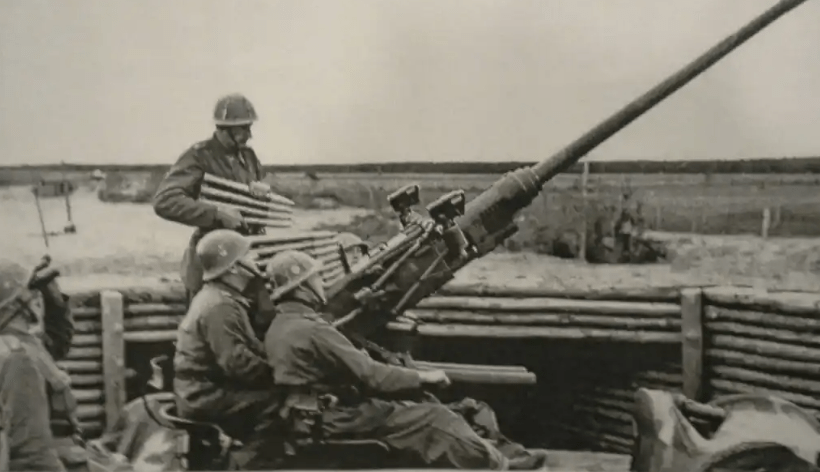
The next day, the troop commander was giving orders in Gothenburg, so twenty-year-old Lieutenant Birger Magnusson alone commanded the conscripts at the two Bofors guns. It was cold on the mountainside that Sunday because spring was unusually late. The government was on full alert because Hitler could not be provoked.
White flag?
Bertil Aronsson, 17 years old, was this weekend off from his spring chase job and was resting on the lawn at home in Ramneröd, north of the city. He heard an engine roar and saw a three-engined aircraft with the Luftwaffe’s Iron Cross on its wings. ”It was flying so low that I could clearly see the swastika.” A Junker 52, Bertil noted. With two engines at high speed and a stationary propeller. Were they planning to make an emergency landing on the regiment’s training field in Samneröd right next door?
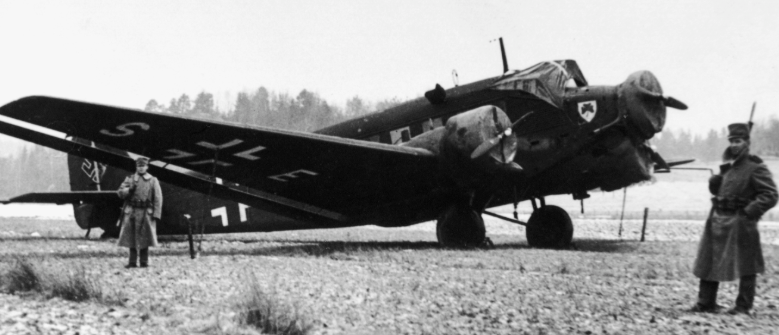
Bertil and also a recruit in the regiment believe they see a white cloth through the cabin window. That is, a parliamentary flag that according to the laws of war signals that one must not be fired upon. Their observation differs from hundreds of others who saw the plane. Also many soldiers mobilized in the barracks. Maybe that is precisely why the Germans wanted to spy?
Circling over the city?
Why fly over the city if there were landing fields all around?
The plane was first seen at Sunningen (at today’s E6 bridge). It was fired upon with rifle fire along Byfjorden and then with a machine gun from Skansberget. It passed through the city center where the air raid siren went off. The regiment met the Junker with warning fire. The plane made a turn westward, again threatened by machine gun volleys from Skansberget.

The plane turns at Fröland (the shipyard area), passes the city center again and draws fire from the Bofors guns. It burns and crashes at Dalslandsvägen (road 172). Whether this account is correct is up to the reader to decide.
The Fury on the Music Mountain
It is believed that the Junker was on its way home after leaving people or cargo in Norway. Perhaps it was a lack of fuel that caused the plane to circle over Uddevalla. Although daylight, it was difficult to navigate in the thick snow. One engine had stopped and the other two were running unevenly. The plane was seen coming over Herrestadsfjället and turning off along the Byfjord.

Even though the two white-painted Bofors guns had only been on Musikberget for a day, the squad was well-trained. The squad leader was in Gothenburg to give orders, so the deputy, twenty-year-old sergeant Birger Magnusson, was responsible. Firing required interaction between scouts with binoculars, a liaison officer, a gunner, a rangefinder, a loader and a gunner. All dressed in the crown’s sheepskin coats because the wind was blowing hard.
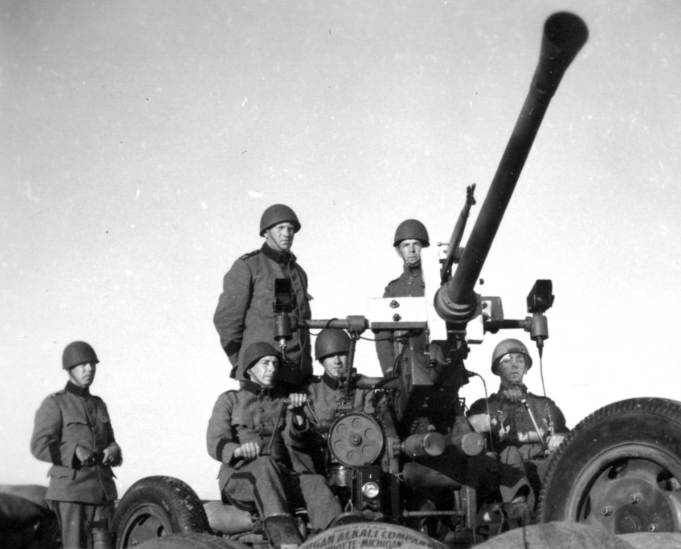
The air raid sirens blared in the city and people rushed to shelters. The scout shouted ”aircraft in sight” and the guns were manned. The first shot with tracer light went as a warning in front of the Junker, without any visible reaction. The plane went straight towards the gun site where Birger ordered effective fire.
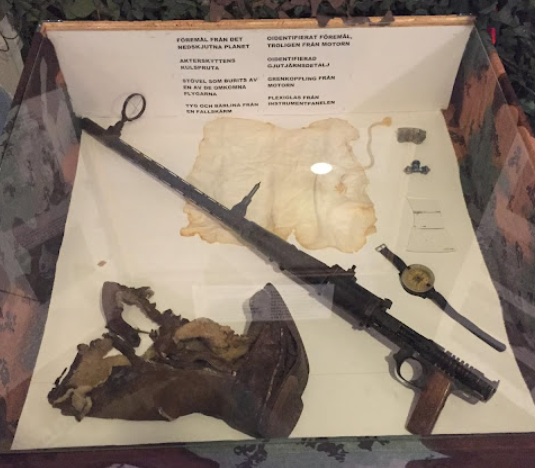
The burning plane with a tail of black smoke disappeared beyond the Kuröd shell banks. The wreckage was discovered near the Dalslandsvägen between Kuröd and Normanneröd. Ammunition exploded and a machine gun was found outside (now at the Bohuslän Defence Museum next to Musikberget).
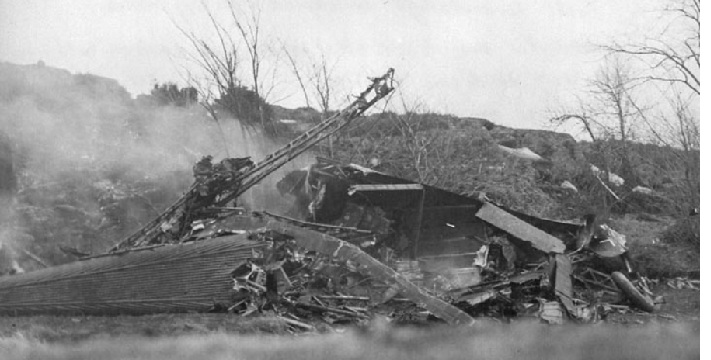
The three members of the crew – Ernst Lück, Heinz Priehäusser and Reinhold Buchhorn – were buried with military honors at Sigelhult Cemetery south of the city, before being moved to Kviberg Cemetery in Gothenburg.

Blackout
The air defense unit on Musikberget was on high alert after more aircraft. On the same day, a Junker 52 had landed paratroopers in Gudbrandsdalen . The plane then made an emergency landing in Lur, north of Grebbestad .

Despite hundreds of spectators, the military leadership and the Ministry of Foreign Affairs claimed on the same day that the German plane had ”collided with a rock wall”.

The Defense Staff called Kuriren and Bohusläningen, the military’s version was to be published. The editors refused. Pictures and details were published, without further explanation. Which made the national press follow suit.

There was talk that officers and non-commissioned officers on I17 were pro-German and even Nazis, of which there were examples. It was therefore alleged that Birger Magnusson was transferred to an anti-aircraft battery in Gravarne, as Kungshamn was then called. The closer the truth was that the piece movement was routine in order to better counter invaders.
Later that spring (date missing) Birger Magnusson helped shoot down another German Junker 54 with anti-aircraft machine guns. The aircraft crashed into the sea off Kungshamn. The newspapers were silent and no protest was heard from Berlin.
Facts
- During the beginning of the war, especially in 1940 in connection with the invasion of Norway, there were a large number of German overflights and reconnaissance flights into Swedish territory, especially over Värmland, Dalarna and Bohuslän.
- Often of the Messerschmitt, Junkers and Heinkel type. In total, there are estimated to be 16,000 such violations during the war, most of them by German aircraft.
- At least 15 German planes were shot down by Swedish anti-aircraft defenses during the war. Three of these in the three weeks after April 9, 1940.
- See the Udevllablog’s articles about Birger Magnusson .
/ By Ingemar Lindmark
 Magasin Hällungen